Renters Insurance for Roommates: Can You Share a Policy?
Roommates can sometimes share renters insurance, but the rules vary by insurer and policy. Under the policies Goodcover currently offers, roommates named on the lease are automatically covered under one policy. They do not need to be individually added to the policy for coverage.
Legacy policy exception: Existing California policies underwritten by Knightbrook did not include roommate coverage. Goodcover no longer offers new Knightbrook policies. If you have one of these legacy policies, check your policy documents and contact Goodcover about your roommate's coverage needs. The automatic lease-based roommate coverage described in this article refers to Goodcover's currently offered policies, not those legacy Knightbrook policies.
A shared policy can reduce cost and simplify a claim, but it also means sharing coverage limits and a deductible. Before choosing, compare that tradeoff with the control and separation of individual policies.
Here's how coverage, claims, cost splitting, and roommate changes work.
Can You Share Renters Insurance With a Roommate?
Yes, it's possible (and recommended) to share renters insurance with your roommate. As long as you're both named on the lease, you'll only file one claim if accidents happen. And when you share a renters policy, the premium you pay is cut in half.
But don't just take our word for it — let's do the math. If you and your roommate split a $20 monthly premium, you're each paying $10.
It's a win-win scenario that ensures you get protection for a fair price. Plus, it's easier to manage one policy than two. If you decided to buy separate policies, you'd have to manage your own individual policy, file separate claims, and pay a larger total premium (and deductible for shared property). With one policy, your workload is essentially cut in half.
Lastly, the first name on the policy is the only person authorized to request changes and remove named insurers.
Does Renters Insurance Cover Your Roommate?
This is the question we hear most, and the answer depends on one thing: the lease.
Goodcover renters insurance covers your personal property and a portion of shared property. It doesn't cover your roommate's stuff unless you're both named on the lease, allowing you to share the policy with them.
If you're both on the lease, the policy will also cover your and your roommate's personal belongings inside and outside the house. At Goodcover, everyone whose name is listed on the lease is automatically covered under one policy — there are no extra steps or hoops required, and you don't need to name each roommate individually.
If your roommate is not on the lease, they aren't covered by your policy and will need their own.
Another perk?
Goodcover does not penalize you or your roommates for insurance claims.
Should I Get Extended Coverage?
Let's be honest, accidents happen — whether it's a water leak ruining your fancy camera or a break-in where you lose valuable jewelry. For accidental-damage protection on eligible valuables, consider scheduled or blanket coverage.
For a small fee, you can upgrade to scheduled or blanket coverage to ensure we replace certain classes of items with zero deductible if they get accidentally damaged as well. That means if you or your roommate spill coffee on your camera or dent your musical instrument, it's covered.
You can choose scheduled or blanket coverage when you first get a quote. Or, you can update it at any time in your Member Dashboard – just visit the Coverage page.
Does Each Roommate Need Renters Insurance?
While each roommate can get their own renters insurance policy, it's generally not recommended if you're sharing property like electronics or furniture. Having separate policies could mean getting only partial reimbursement for shared items in case of a loss.
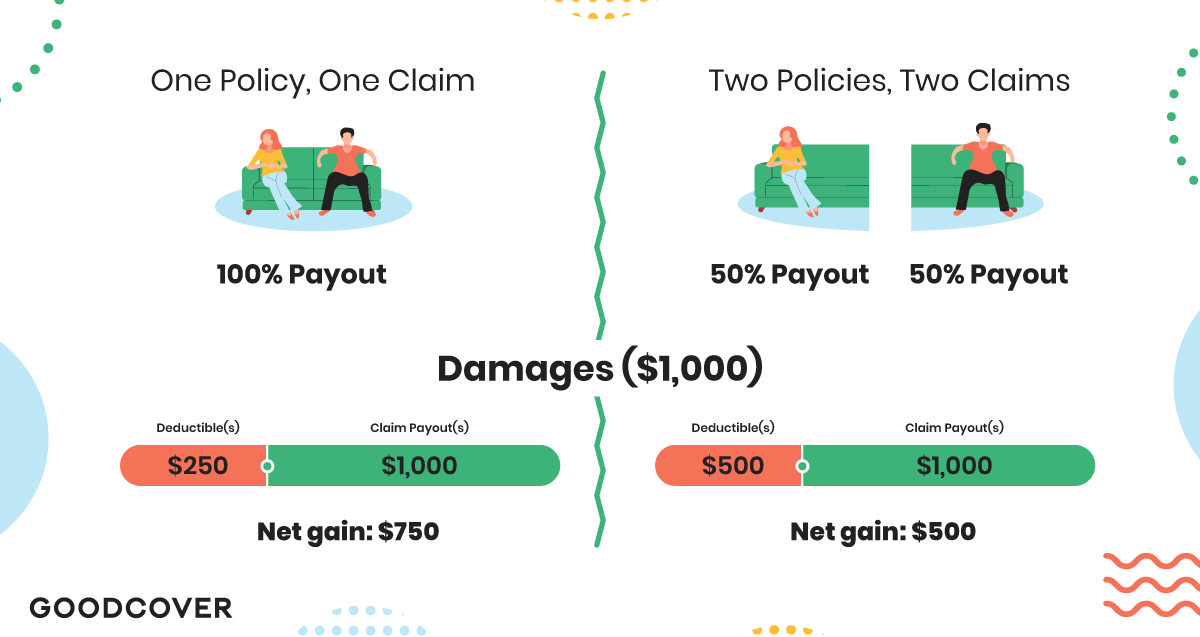
Let's use a shared couch as an example. You both pitched in to buy a $1,000 couch for your shared living room.
If a fire breaks out and destroys the couch, each of your separate renters insurance policies would typically cover only half of the couch's value. That's because insurance claims payout is based only on what the insured individual owns — which, in this case, is 50% of the replacement cost value (RCV).
One vs two policies
Instead of going through two claim processes with a payout of $500 each and twice the amount of deductibles (totaling $500), you and your roommate could file a single claim through a joint policy that nets you the couch's value ($1,000) minus a single deductible ($250).
That means a joint policy would net you $750 out of the couch's original value, as opposed to the $500 total payout you'd get by filing two individual claims. It's simply more time-efficient and cost-effective.
The same logic applies to events (e.g., a friend falling at your place) where both of you might be held liable. Your shared personal liability coverage would help expedite the claim and, in turn, the reimbursement.
Overall, while each roommate should be protected, it's okay for roommates to share one policy.
Renters Insurance for Multiple Roommates and Group Policies
What if there are three, four, or more of you? The same rule applies: with Goodcover, every person named on the lease is covered under a single policy, however many of you there are. There's no separate "group renters insurance" product to buy and no per-person surcharge for adding roommates to the lease.
A few things change as the household grows, though:
- Your coverage limit matters more. One policy has to stretch across everyone's belongings. Four people's combined furniture, electronics, and clothes add up faster than two people's, so check that your personal property limit reflects the whole household, not just your own room.
- One person holds the reins. However many roommates are covered, only the first named insured can request changes or receive a claims payout. In a larger house, agree up front on who that will be.
- Splitting gets more complicated. An even split across four people is easy arithmetic, but the odds that everyone owns roughly the same amount of stuff go down as the group grows. See the cost-splitting methods below.
If one roommate would rather carry their own policy, they certainly can — sharing is an option, not a requirement.
What Does It Mean To Share a Renters Insurance Policy With Someone?
Sharing coverage is different from listing someone as an interested party.
- A covered roommate: Under Goodcover's currently offered policies, a roommate named on the lease is automatically covered. They do not need to be individually named on the policy for coverage.
- A named insured: A person identified by name as an insured on the policy. This is not the same as an interested party or an additional insured.
- An interested party: Someone, often a landlord or property manager, listed to receive proof of insurance and policy-status notices. Being listed as an interested party does not make that person insured under your policy.
A shared policy has shared coverage limits; each roommate does not receive a separate personal property limit. Review the combined value of your belongings when choosing coverage.
Automatic coverage does not, by itself, tell you who can manage the account or how a claims payment will be handled. Ask Goodcover if you need to confirm those details.
Deliberate damage and disputes between roommates can raise coverage questions. Check the policy's exclusions rather than assuming every incident is covered.
Why Sharing Renters Insurance With Roommates Is Smart
Sharing a renters insurance policy with your roommates is a great option. Here's why:
- You'll save money: Imagine your renters insurance costs $20/month. If you share with a roommate, you each pay just $10! It's a simple way to cut costs.
- It keeps things simple: One bill, one renewal date – no more juggling multiple policies. Sharing streamlines everything and makes it easier to stay on top of your coverage.
- Insurance claims are easier: When you share a Goodcover policy, filing a claim is a breeze. Everyone involved is covered and we make it simple for everyone to get reimbursed for their belongings. Plus, you'll have a bigger net payout than if you all had to pay separate deductibles.
- Builds trust and cooperation: A shared policy can be a sign of trust and encourage everyone to take responsibility for the shared space.
When Sharing Renters Insurance Might Not Be the Best Fit
While sharing renters insurance is a smart move, there are a few situations where separate renters insurance policies might be the logical option:
- Strained relationships: If there's a serious lack of trust or communication among roommates, sharing a policy can lead to conflict. In such cases, each roommate needs their own individual policy for peace of mind.
- High-risk lifestyle roomies: If a roommate engages in activities that increase the risk of accidents or damage (e.g., frequent parties or owning a pet with a history of aggression), having separate policies can ensure that individual risks don't affect everyone's coverage.
What To Look For in the Best Renters Insurance for Roommates
Once everyone's on board, it's time to find the right policy. The best renters insurance for a shared household isn't always the cheapest one — it's the one whose limits and terms fit everyone living there. Consider these factors:
- Coverage limits: How much will the policy pay out if your belongings are damaged or stolen? All Goodcover policies come with replacement cost coverage, meaning you'll get enough money to replace your items new (up to your coverage limits, of course).
- Deductible: This is the amount you'll pay out of pocket before the insurance kicks in. A lower deductible means your annual premium will be higher, while a higher deductible will lower your annual premium. Learn more about deductibles here.
- Whether roommates are covered automatically: Some insurers require every roommate to be added as a named insured, and some won't cover unrelated roommates at all. With Goodcover, everyone on the lease is covered by default.
- Claims history questions: Some insurers use prior claims when setting premiums. Goodcover does not penalize you or your roommates for insurance claims.
- How easy it is to make changes: Roommates come and go. Look for a policy you can adjust yourself, online, without calling an agent.
Get quotes from multiple providers and find the best deal for your needs. At Goodcover, you can get a renters insurance quote faster than you can listen to your favorite song, and you can even bind your policy right from the comfiest spot on your couch – no agents, no big fuss. Just simple, modern insurance.
How To Split Renters Insurance Costs Fairly: 3 Methods
- The Equal Split: The simplest option is to divide the cost evenly among roommates. This works well if everyone has similar belongings and coverage needs.
- Pros: Easy, simple, straightforward.
- Cons: May not be fair if some roommates have significantly more valuable items.
- The Proportional Split: This method takes into account the value of each roommate's belongings. Those with more expensive items pay a larger share of the premium.
- Pros: More equitable in some cases.
- Cons: Can be tricky to determine the value of belongings, and some might feel uncomfortable disclosing this information.
- The Room Size/Usage Split: Here, the cost is split based on room size or how much each roommate uses shared spaces.
- Pros: Takes into account individual living situations.
- Cons: May not reflect the actual value of possessions.
Some roommates opt for a hybrid approach, combining elements of these methods. For instance, you could split the base cost equally and adjust for individual property values.
The best way to figure out what you'll pay is to get a free, instant Goodcover quote. Simply answer a few questions and see your pricing update in real-time.
The Roommate Insurance Talk: How To Avoid Awkwardness
Talking about money can be awkward, but it's necessary to have an open and honest conversation about renters insurance with your roommates. Here are some icebreakers to get you started:
- "What are the most important things you'd want to replace if something like a fire happened in our place?"
- "How much do you think it would cost you to replace those things out of pocket?"
- "How much are we comfortable spending on insurance each month?"
- "Should we get a joint policy or individual ones?"
Pro tip: Discuss potential conflicts upfront. For example, what if one roommate has more valuable stuff that could increase your monthly premium? How will you handle disagreements about whether to file a claim? Addressing these issues early on can prevent major headaches later.
Put It in Writing: The Roommate Insurance Pact
To avoid misunderstandings and potential conflicts, put your cost-sharing agreement in writing. Include:
- How much each roommate pays.
- Payment deadlines.
- How you'll handle changes to the policy or cost-sharing arrangement.
Make sure every roommate entering the agreement signs and gets a copy.
Life Happens: Handling Roommate Changes
Roommate situations are rarely static. People move out, new people move in, and your belongings change over time. It's important to revisit your policy and cost-sharing agreement whenever there's a change. For example:
- New roommate: They'll need to be added to the lease for your existing Goodcover policy to extend coverage to them. If they're not on the lease, they'll need their own policy. Discuss their coverage needs and adjust the cost-sharing arrangement accordingly.
- Roommate moving out: Review the lease, your coverage needs, and your cost-sharing agreement when someone leaves. If the departing roommate is the named policyholder, contact Goodcover to confirm what changes are needed. Do not assume that removing someone as an interested party changes who is covered.
- Big purchase: If someone buys a pricey item, consider adjusting the split to reflect the increased value of their belongings.
- Inflation: Prices go up, and inflation affects your renters insurance coverage. It's wise to review your policy annually to ensure your coverage limits are still adequate.
How Goodcover Handles Renters Insurance for Roommates
Under Goodcover's currently offered policies, roommates named on the lease are automatically covered under one policy. They do not need to be individually added to the policy for coverage. Existing California Knightbrook policies are a legacy exception: they did not include roommate coverage and are no longer available for new purchases.
It doesn't matter how much stuff you and your roommates have, there's a coverage fit for you. If you have a roommate with a significantly more valuable collection of belongings, use the cost-splitting methods above to divide the premium in a way that reflects it.
For extra peace of mind, consider scheduled or blanket coverage to protect musical instruments, cameras, or jewelry and watches with accidental damage protection and deductible-free claims. Not sure how much coverage you need? Learn how to create a home inventory to determine the value of your stuff.
To get an idea of what you'll pay, you can get an instant and free online renters insurance quote from Goodcover. Simply enter your details, adjust your coverage levels, and get insured in under a minute. No long forms, no waiting for an insurance agent to finalize your policy — just simple, convenient, affordable renters insurance.
Important Considerations for Shared Policies
Even if you decide to share a policy, here are a few important factors to keep in mind:
- Coverage limits: Ensure you have enough coverage so the combined value of everyone's belongings doesn't exceed the policy's coverage limit. If one roommate has a lot of valuable stuff, you may need to customize the coverage accordingly. Goodcover can help you determine the right amount of coverage for everyone's needs. If you get stuck, just contact us.
- Communication is key: Keep an open dialogue with your roommates about your policy. Discuss any changes in belongings or living situations that might require adjustments to the coverage.
- Know your policy: Understand the terms and conditions of your policy, including how claims are handled and what happens if a roommate moves out. Like all insurance policies, renters insurance does have some exclusions, so make sure to read your policy carefully.
Final Thoughts: What You Need To Know About Renters Insurance for Roommates
Under Goodcover's currently offered policies, roommates named on the lease are automatically covered. They do not need to be individually named on the policy for coverage. Existing California Knightbrook policies did not include roommate coverage and are no longer available for new purchases.
A shared policy can simplify household insurance costs, but the coverage limits must fit everyone's belongings. Discuss cost sharing, review your policy's terms, and contact Goodcover if you're unsure which coverage applies.
Get a Goodcover renters insurance quote.
Note: This post is for informational purposes; insurance regulation and coverage specifics vary by location and person. Check your policy for exact coverage information.
For additional questions, reach out to us – we're happy to help.